
1946 Zhenjiang, China
Shufang Liu
1929
Xuanbao Town, Taixing City, Jiangsu Province, China
Interviewed on February 12, 2022
By Michael Chen
(Translated from Mandarin)
When we were little, we rarely had the opportunity to go to watch movies. They were a luxury at the time. It wasn’t that we were too poor, but more that there weren’t any new movies coming to our town. I just remember when I was 7, my father took me to see a silent, black and white movie. I can’t remember too much of it, and I don’t remember the name of it. That was when I was 7, I’m 94 now so that was in 1935 or 1936. I just remember there were a lot of people riding bicycles in the movie. My father, your mom’s grandfather, was a doctor, and he would always be the first to pick up on the latest novelties, such as the phonograph, radio, and bicycles, so that’s why he took me to see the movie as well. When they first came out, he would also wear sunglasses, carry a cane with him, and keep the types of hats worn by Napoleon on his head. We watched the movie outside, at my elementary school, Xuanbao Elementary School, and we walked to get there. It was the second best elementary school. The way they would show movies back then was that people would ride from village to village on bicycles carrying cartridges, and project the movie on the village square.
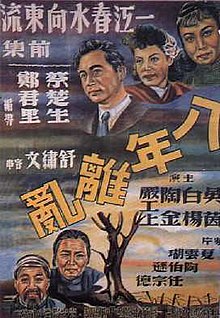
It wasn’t until I was 17 that I watched my next movie in Zhenjiang, where I went to a college for teachers. This time the movies were inside a theater, called Zhong Hua Yin Ju Yuan. We still had to walk, of course, since there were no cars. There was 一江春水向東流 (The Spring River Flows East), 马路天使 (Street Angel), and 夜半歌声 (Song at Midnight). I remember The Spring River Flows East, which was about the Chinese anti-fascist resistance to Japanese invasions. The army was traveling from the northeast and traveling south to Shanghai. The movie made everyone excited to join the volunteer armies to fight Japan. That was what made everyone excited: fight Japan! College students were so roused with patriotism and they were preaching for everyone to join the Chinese army. They hijacked a train and redirected it from the northeast all the way down to Nanjing. They were chanting “Kang Ri” (抗日), meaning resist Japan, and they were petitioning and demanding the government, the Kuomintang, which was hesitant at the time, to go in and defeat the Japanese. Students were singing songs from the movie and were so riled up that some of them started crying.
Song at Midnight was a little bit scary. I think in America there is something similar [Phantom of the Opera]. One of the characters got his face burned and ruined by acid, and it was quite gruesome. Somebody in the audience was so shocked when they unmasked the disfigured face that they had to go to the hospital afterwards.
In Street Angel, I remember that there was a couple getting married. I also remember the woman was singing a song. I remember some of the actors too. The woman’s name was Zhou Xuan, who died when she was young in a mental asylum.
There was only one movie theater that we could go to, called Zhong Hua Yin Ju Yuan. There weren’t choices. Obviously, there was no food to buy at the theaters. The school prohibited students from going off campus every day except for Sundays. That was the only day we could go to the theater, and we still had to get permission from the school to go. We had to pay for it ourselves, pay for our own tickets. Our college was government sponsored, and every month we would get 1 yuan. Movie tickets were not too expensive, but it was still not something we did too often. We went outside often and liked to climb mountains, get our hair styled, buy other goods, and if we had enough money leftover we would watch a movie.
